Your engineering team is the biggest asset of your organization. They work tirelessly on software projects, despite the tight deadlines.
However, there could be times when bottlenecks arise unexpectedly, and you struggle to get a clear picture of how resources are being utilized. Businesses that utilize project management software experience fewer delays and reduced project failure rates, resulting in a 2.5 times higher success rate on average. Companies using project management practices report a 92% success rate in meeting project objectives.
This is where an Engineering Management Platform (EMP) comes into play. EMPs are used by agile teams, development teams, and software development teams to manage workflows and enhance collaboration. They are designed to handle complex projects and can manage the intricacies of a complex system.
An EMP acts as a central hub for engineering teams. It transforms chaos into clarity by offering actionable insights and aligning engineering efforts with broader business goals.
EMPs are particularly valuable for engineering firms and professional services firms due to their industry-specific needs.
In this blog, we’ll discuss the essentials of EMPs and how to choose the best one for your team.
Engineering Management Platforms (EMPs) are comprehensive tools and project management platform that enhance the visibility and efficiency of engineering teams. They serve as a bridge between engineering processes and project management, enabling teams to optimize workflows, manage project schedules and team capacity, track how they allocate their time and resources, perform task tracking, track performance metrics, assess progress on key deliverables, and make informed decisions based on data-driven insights. The right engineering management software should provide actionable insights based on the performance metrics of your team. This further helps in identifying bottlenecks, streamlining processes, and improving the developer experience (DX). Businesses that utilize engineering management software experience fewer delays and reduced project failure rates, so they're 2.5 times more successful on average.
One main functionality of EMP is transforming raw data into actionable insights, serving as a software engineering intelligence tool that provides data-driven insights into team productivity and performance. This is done by analyzing performance metrics to identify trends, inefficiencies, and potential bottlenecks in the software delivery process.
The Engineering Management Platform helps risk management by identifying potential vulnerabilities in the codebase, monitoring technical debt, and assessing the impact of changes in real time.
These platforms foster collaboration between cross-functional teams (Developers, testers, product managers, etc). They can be integrated with team collaboration tools like Slack, JIRA, and MS Teams. EMPs can also facilitate client management by streamlining communication and workflows with clients, ensuring that contracts and operational processes are efficiently handled within the project lifecycle. It promotes knowledge sharing and reduces silos through shared insights and transparent reporting. Communication tools in an engineering management platform should include features like discussion threads and integrations with messaging apps for seamless communication.
EMPs provide metrics to track performance against predefined benchmarks and allow organizations to assess development process effectiveness. By measuring KPIs, engineering leaders can identify areas of improvement and optimize workflows for better efficiency. Additionally, EMPs help monitor and enhance project performance by offering detailed metrics and analysis, enabling teams to track progress, allocate resources effectively, and improve overall project outcomes.
Developer Experience refers to how easily developers can perform their tasks. When the right tools are available, the process is streamlined and DX leads to an increase in productivity and job satisfaction. Engineering Management Platforms (EMPs) are specifically designed to improve developer productivity by providing the right tools and insights that help teams work more efficiently.
Key aspects include:
Engineering Velocity can be defined as the team's speed and efficiency during software delivery. To track it, the engineering leader must have a bird's-eye view of the team's performance and areas of bottlenecks.
Key aspects include:
Engineering Management Software must align with broader business goals to help move in the right direction. This alignment is necessary for maximizing the impact of engineering work on organizational goals.
Key aspects include:
The engineering management platform offers end-to-end visibility into developer workload, processes, and potential bottlenecks. It provides centralized tools for the software engineering team to communicate and coordinate seamlessly by integrating with platforms like Slack or MS Teams. It also allows engineering leaders and developers to have data-driven and sufficient context around 1:1.
Engineering software offers 360-degree visibility into engineering workflows to understand project statuses, deadlines, and risks for all stakeholders. This helps identify blockers and monitor progress in real-time. It also provides engineering managers with actionable data to guide and supervise engineering teams.
EMPs allow developers to adapt quickly to changes based on project demands or market conditions. They foster post-mortems and continuous learning and enable team members to retrospectively learn from successes and failures.
EMPs provide real-time visibility into developers' workloads that allow engineering managers to understand where team members' time is being invested. This allows them to know their developers' schedule and maintain a flow state, hence, reducing developer burnout and workload management.
Engineering project management software provides actionable insights into a team's performance and complex engineering projects. It further allows the development team to prioritize tasks effectively and engage in strategic discussions with stakeholders.
The first and foremost point is to assess your team's pain points. Identify the current challenges such as tracking progress, communication gaps, or workload management. Also, consider Team Size and Structure such as whether your team is small or large, distributed or co-located, as this will influence the type of platform you need.
Be clear about what you want the platform to achieve, for example: improving efficiency, streamlining processes, or enhancing collaboration.
When choosing the right EMP for your team, consider assessing the following categories: features, scalability, integration capabilities, user experience, pricing, and security. Additionally, having a responsive support team is crucial for timely assistance and effective implementation, ensuring your team can address issues quickly and make the most of the software. Consider the user experience when selecting engineering management software to ensure it is intuitive for all team members.
Most teams are adopting AI coding tools faster than they’re measuring their effects. That gap is where engineering management platforms matter. The useful ones don’t just show “how much AI was used.” They track acceptance rates, review rework, time-to-merge shifts, and whether AI-generated code actually improves throughput without dragging maintainability. Adoption without this level of measurement is guesswork. With it, you can see where AI is helping, where it’s creating silent complexity, and how it’s reshaping the real cost and pace of delivery.
A good EMP must evaluate how well the platform supports efficient workflows and provides a multidimensional picture of team health including team well-being, collaboration, and productivity.
The Engineering Management Platform must have an intuitive and user-friendly interface for both tech and non-tech users. It should also include customization of dashboards, repositories, and metrics that cater to specific needs and workflow.
The right platform helps in assessing resource allocation across various projects and tasks such as time spent on different activities, identifying over or under-utilization of resources, and quantifying the value delivered by the engineering team. Resource management software should help managers allocate personnel and equipment effectively and track utilization rates.
Strong integrations centralize the workflow, reduce fragmentation, and improve efficiency. These platforms must integrate seamlessly with existing tools, such as project management software, communication platforms, and CRMs. Robust security measures and compliance with industry standards are crucial features of an engineering management platform due to the sensitive nature of engineering data.
The platform must offer reliable customer support through multiple channels such as chat, email, or phone. You can also take note of extensive self-help resources like FAQs, tutorials, and forums.
Research various EMPs available in the market. Now based on your key needs, narrow down platforms that fit your requirements. Use resources like reviews, comparisons, and recommendations from industry peers to understand real-world experiences. You can also schedule demos with shortlisted providers to know the features and usability in detail.
Opt for a free trial or pilot phase to test the platform with a small group of users to get a hands-on feel. Afterward, Gather feedback from your team to evaluate how well the tool fits into their workflows.
Finally, choose the EMP that best meets your requirements based on the above-mentioned categories and feedback provided by the team members.
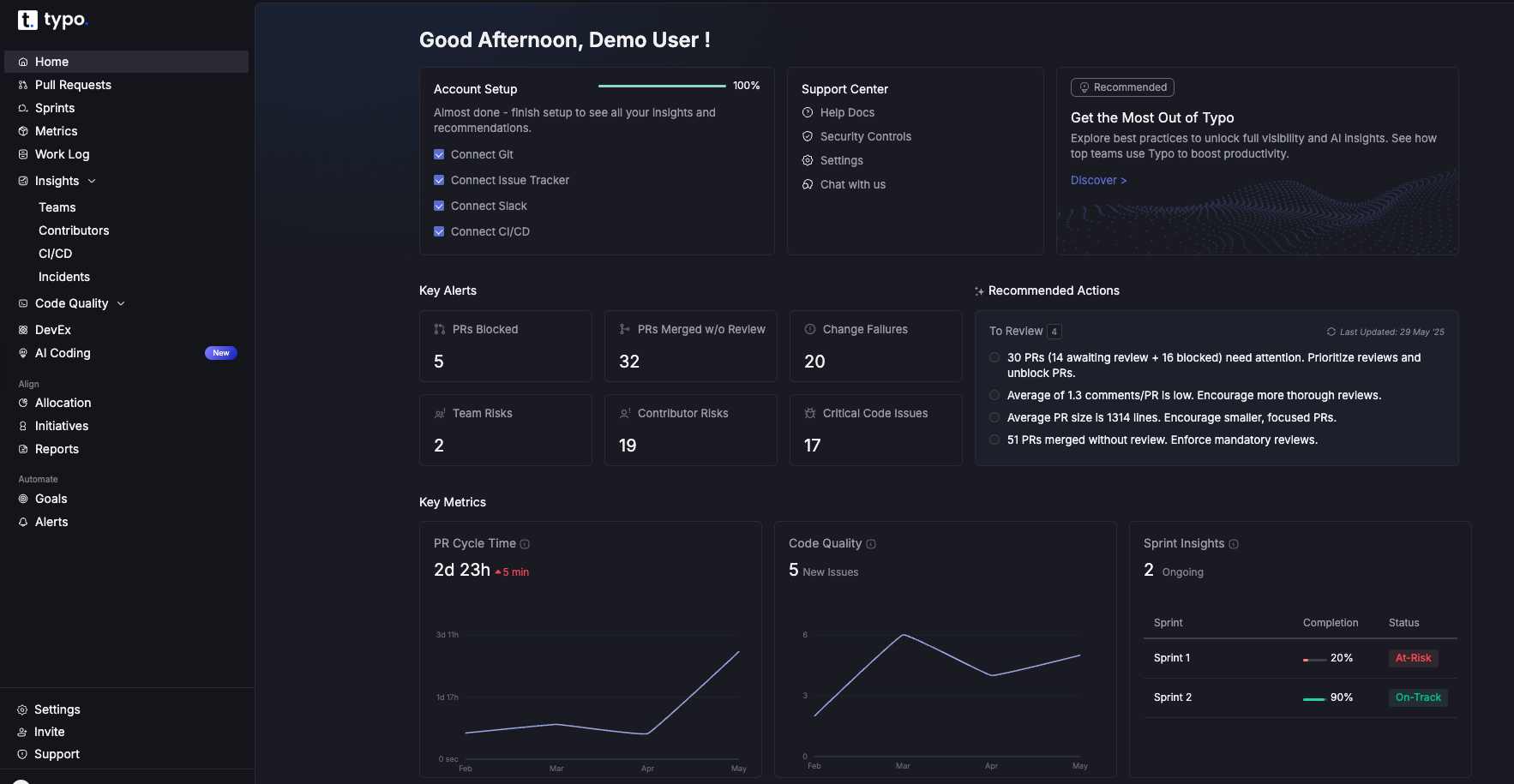
Typo is an effective engineering management platform that offers SDLC visibility, developer insights, and workflow automation to build better programs faster. It can seamlessly integrate into tech tool stacks such as GIT versioning, issue tracker, and CI/CD tools.
It also offers comprehensive insights into the deployment process through key metrics such as change failure rate, time to build, and deployment frequency. Moreover, its automated code tool helps identify issues in the code and auto-fixes them before you merge to master.
Typo has an effective sprint analysis feature that tracks and analyzes the team's progress throughout a sprint. Besides this, It also provides 360 views of the developer experience i.e. captures qualitative insights and provides an in-depth view of the real issues.
Successfully deploying an engineering management platform begins with comprehensive analysis of your engineering team's existing workflows and the technological stack already integrated within your development ecosystem. Engineering leaders should dive into mapping current toolchains and processes to identify API integration points and leverage optimization opportunities across the software development lifecycle. Automated workflow transitions help reduce lead time in software development. Engaging key stakeholders—including project managers, software engineers, and cross-functional team members—early in the deployment process ensures that diverse requirements and technical constraints are addressed from the initial phase.
A phased implementation strategy leverages iterative deployment methodologies, enabling engineering teams to gradually adapt to the new management platform without disrupting ongoing development sprints and project delivery pipelines. This approach also facilitates continuous feedback loops and real-time adjustments, ensuring seamless integration across distributed teams and microservices architectures. Comprehensive onboarding sessions and continuous support mechanisms are critical for accelerating user adoption and maximizing the platform's transformative capabilities.
By strategically orchestrating the deployment process and providing necessary technical resources, organizations can rapidly enhance resource optimization, streamline cross-team collaboration, and gain unprecedented visibility into project velocity and delivery metrics. This data-driven approach not only minimizes change resistance but also accelerates time-to-value realization from the new management infrastructure.
Advanced engineering management algorithms serve as the foundational framework for orchestrating complex engineering project ecosystems that align with strategic business objectives. Engineering managers and technical leaders must implement comprehensive project planning architectures that systematically define deliverables, establish milestone checkpoints, and map inter-dependencies across development workflows. Implementing data-driven timeline optimization algorithms and ensuring precision resource allocation through machine learning-powered capacity planning are critical components for maintaining project trajectory alignment and budget constraint adherence.
Deploying sophisticated task management platforms—including Gantt chart visualization systems, agile board orchestration tools, and Kanban workflow engines—enables development teams to monitor real-time progress metrics, optimize workload distribution algorithms, and proactively identify potential bottleneck scenarios through predictive analytics. Continuously analyzing performance indicators through automated monitoring systems—encompassing developer productivity coefficients, technical debt accumulation patterns, and project profitability optimization models—empowers engineering management frameworks to execute data-driven decision algorithms and implement automated corrective action protocols.
Establishing continuous improvement architectures through cultural transformation algorithms proves equally critical for organizational optimization. Implementing feedback collection mechanisms, deploying achievement recognition frameworks, and supporting professional development pathways through machine learning-driven career progression models contribute to enhanced job satisfaction metrics among software engineering personnel. Through adopting these algorithmic best practices and leveraging integrated engineering management platforms, organizations can amplify operational efficiency coefficients, support strategic initiative execution, and ensure successful delivery optimization across multiple project pipelines. This comprehensive systematic approach not only enhances project outcome metrics but also strengthens team health indicators and long-term business performance optimization.
An Engineering Management Platform (EMP) not only streamlines workflow but transforms the way teams operate. These platforms foster collaboration, reduce bottlenecks, and provide real-time visibility into progress and performance.


Implement engineering metrics, gather SDLC insights & set continuous improvement goals in your dev teams.
Try Live Demo
We're on a mission to build engaged, productive tech teams. Try it out for free!


Follow us on: